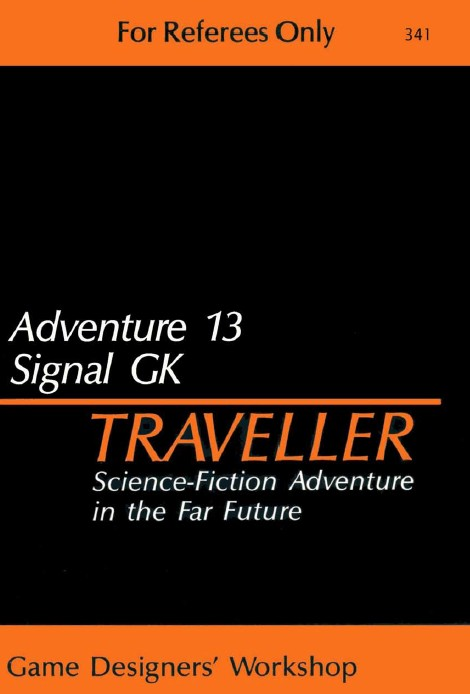
1985 is over 40 years ago. Why am I reviewing it now? Well, I
recently ordered Adventure 14: Travel
Hazards from Mongoose. I’m waiting for the
physical booklet to read the adventure in detail, but I
couldn’t resist taking a peek at the pdf. And I noticed
something slightly odd about the layout – unnecessary
indents on paragraphs that follow a heading.
I’m sure Mongoose know better than to do that to a
layout, so I got Signal GK down
off the shelf, flipped it open, and sure enough, Mongoose
appear to be replicating the old GDW format exactly –
even down to the pregenerated characters and the unnecessary
indents.
And having taken Signal GK off
the shelf, I started reading, and here we are.
So, anyway, this is a first-impressions review. I
haven’t run Signal GK
– and as we’ll see, I probably won’t.
Oh, and spoilers ahead.
A physical copy of Adventure 13? Really?
Some years ago, probably longer than I care to admit, I got
rid of most of my old Traveller
LBBs. I wasn’t playing the game, I wasn’t reading
them, and they were just taking up space. So I got rid of most
of them.
I kept the books I really liked. Twilight’s
Peak. Secret of the Ancients
(not that I liked that one, but it had Ancients in it). IISS Ship Files (in my opinion, the
best Traveller deck plans
ever). The alien modules. And Signal
GK.
I’m not sure why I kept Signal
GK. I certainly never ran it. I can only think that
the central premise in it (the silicon-chip lifeform) was
sufficiently appealing that I wanted to keep it. Or maybe it
was that those lifeforms led directly to the controversial
Virus and the destruction of the Third Imperium. I really
can’t remember, but either way, I still have my original
copy of Signal GK.
All this is preamble! Where’s your review?
Patience, I’m getting there.
Before starting to write this, I thought I’d check and
see what other reviewers had to say about Signal
GK. And the answer is… nothing. At least, not
in text. I found a single video review of Signal
GK – and that’s it.
So this is my text review of Traveller
Adventure 13: Signal GK. Maybe
the only one on the Internet.
Overview
Signal GK is a 48-page booklet
for Traveller set on the border
between the Solomani Confederation and Third Imperium. The
adventure is broadly in three parts. First, the PCs must help
Dr Roshorin, a Solomani researcher, defect to the Imperium.
Then the PCs accompany Dr Roshorin to Cymbeline to confirm his
theories. There, they find an intelligent silicon-chip-based
lifeform. Finally, the PCs accompany Dr Roshorin to Terra
aboard the Ad Astra, a 600-dton
Subsidized Liner, where a Solomani agent tries to kill Dr
Roshorin.
(Signal GK is also the Vilani interstellar distress call. I
imagine that the title of the adventure refers to the Ad
Astra’s distress call after the bombing.)
Maps, deck plans, library data
As well as the adventure, Signal GK
provides plenty of supplemental information:
The Ad Astra:
14 pages of details of the Ad Astra
liner, including illustrations, room-by-room descriptions and
deck plans. This is rather nice, and I imagine that back in
1985, many referees bought the adventure just for the deck
plans.
The Solomani Border: A two-page spread
showing the area in question. The map is subsector-sized, but
straddles four subsectors to show all the worlds it needs for
the adventure.
Library data: Two pages of library data.
The Biology of Natural Chips: Four pages
about how natural silicon chips evolved on Cymbeline. This is
lovely – I’m all for weird alien lifeforms.
All that adds up to 22 pages. And when you include the
contents page, the front matter, and a boilerplate
introduction (another five pages), that means less than half
of the book is actual adventure material. Not that I’m
complaining; as I’ve said before, I find a lot of
adventures are overwritten. Signal GK
isn’t one of them.
The adventure
The set-up is that after failing to find gainful employment
on Scandia (just because…), the PCs are hired by
Colonel Joachim Sanchex, the head of the Imperial Army
Intelligence, to secure the defection of an important Solomani
scientist. They are well paid and given a Type S scout for the
mission.
Now, quite why Sanchex would choose a group of
ne’er-do-wells like the PCs isn’t well explained.
Deniable assets, perhaps. I think this is so that GMs can just
drop Signal GK into their
regular Traveller campaigns
– although that has never made sense to me. The number
of Traveller groups running
campaigns in that neck of the Solomani Rim was probably in the
low tens. If that.
I imagine that if anyone did run Signal
GK, they either moved it (in which case they’d
be rewriting all sorts of stuff) or ran it as a one-shot
(which is what I would do). And with a one-shot, we can let
the players create Imperial Army agents with the skills they
think they will need.
(I would start the game with Sanchex briefing the players and
instructing them to plan the mission and assemble a team. The
players would then create and equip those characters to suit
the mission profile – and then play them.)
Pedant’s corner: The introduction on
page 5 says, “the players may use pregenerated
characters supplied later in this adventure. A complete
roster of available characters is supplied in a specific
section of this booklet; these can be used both as player
and non-player characters.” Unfortunately, there
is no such section. The only characters in Signal
GK are the main NPCs.
Structure
Before I get into the adventure proper, I just want to
comment on Signal GK’s
weird structure. I’m sure it made sense to GDW, but it
doesn’t make sense to me. These are the sections:
- Introduction
- Referee’s synopsis
- Characters (actually the NPCs)
- On Ochre (the first part of the adventure)
- The Ad Astra (14 pages of description and deck plans of
the Ad Astra)
- The Solomani Border (the subsector map)
- On Cymbaline (the second part of the adventure)
- Disaster (part three of the adventure)
- The Biology of the Natural Chips
- Library Data
- Referee’s Notes
That’s not how I would structure the book. The section
on the Ad Astra, in particular,
breaks the flow of the adventure. I would rearrange it so that
the adventure is kept together and the supplemental
information (Ad Astra, Chip
Biology, and Library Data) is pushed to the back.
I would move the Solomani Border section directly after
Characters, as it helps explain the overall political
situation.
Anyway.
High-tech adventure
One thing that’s striking about Signal
GK is how high-tech it all is. Well, it would be
striking if it actually felt high-tech…
Looking at the map, pretty much every world is TL 9 or higher
– often much higher. Signal GK
starts on TL 15 Scandia and moves to TL 14 Ochre and
Cymbeline. By 2026 standards, these are magical worlds full of
technological miracles. TL 15 has black globe generators and
anagathics. TL 14 has cloning and robots. And that’s
just what I can find in 1982’s The
Traveller Book. Mongoose’s core rules add
floating cities, implants and high-energy weapons and probably
more if I looked a little harder.
But Traveller in 1985
hasn’t quite worked it out. (As an example, on Ochre, a
research facility is described as being reachable via a
dirt-track road, which is used as a visual aid by grav
vehicles. I’d change that. In a TL14/15 society, why
would there be any roads at all?)
But I think the very high-tech environment has interesting
implications for smuggling defectors.
Part 1: Ochre
Ochre is a small desert world with its population clustered
around the polar regions. It is two parsecs from the nearest
Imperial world (Tamarind), and being so close is a focal point
for traffic (and smugglers) between the Solomani Rim and the
Third Imperium. The local government is relaxed about
smuggling (despite its strict law level) because of the income
it brings in from passage fees and inspection duties, and the
Solomani Confederation tolerates the smuggling because it is a
channel for acquiring Imperial goods and technology. So
it’s a leaky border.
So the PCs must cross the border, arrive on Ochre, find and
make contact with Dr Roshorin, convince him that they are
genuine, and then smuggle him out across the border without
the Solomani authorities finding out.
And while Signal GK describes
the overall situation on Ochre, it gives no details on how any
of that is to be done. I think that’s for the best
– letting the GM and players define the world of Ochre
will lead to a memorable game. If nothing else, it gives the
players huge freedom in how they approach their mission
– they’re not constrained by preplanned set pieces
or scenes.
Traveller’s politics
The Solomani are the bad guys in Signal
GK. So who are they?
It’s 1110 now, and the Solomani Rim War was in
990-1002. So 108 years ago, which by coincidence is how long
ago WW1 ended, measured from 2026. So the Rim War is pretty
much in living memory – particularly given the
anagathics users present on all those TL 15 worlds. (I would
make Colonel Sanchex a veteran of the war.)
The war erupted when the Solomani attacked the Imperium in a
land grab. However, the Imperium fought back and won, and now
occupies half of the previous Solomani territory. (So Scandia,
our starting world, is, to many eyes, an occupied world.)
The Solomani Confederation is described as having
“belligerent and extremist policies,” but Signal
GK says little more than that (and I’m
reluctant to dig into the wider Traveller
background just for this review).
I have the impression that the Solomani Confederation is a
bit like the Cold War-era Soviet Union or East Germany.
(Although the Imperium are the occupying force here…)
And that’s probably how I would play it.
Defection
Defection is a loaded term. Dr Rushorin doesn’t want
to leave the Solomani Confederation; he wants
to defect. That reinforces the sense of East/West Cold
War tensions that I get from the politics.
So while smuggling might be easy (as discussed above),
defecting must be harder.
Presumably, the Solomani Confederation considers Dr Rushorin
a valuable asset that they don’t want to lose. And
having valuable assets working near the border means he will
be watched (with TL 14 surveillance). And presumably, he is
prohibited from leaving Solomani space.
One of the challenges that real-life defectors faced was what
happened to their families. (Although I say this as someone
with no personal experience of this!) I imagine defection is
much harder if you suspect your family would be threatened.
Unfortunately, Signal GK lacks
this dimension. All we know is that Dr Rushorin is a professor
at a university on Aquitaine, and is on sabbatical. He is on
Ochre, working on an electronics research project and wants to
defect to the Imperium before he has to return to Aquitane.
Still, it would be easy to give Dr Rushorin a small family
that he has brought with him to make the PCs’ task
harder.
Back to Scandia
Anyway, after all this, the PCs smuggle Dr Rushorin across
the border and to Scandia. Solomani Security are soon in
pursuit, however… (How soon depends on how effective
the PCs have been.)
Part 2: Cymbeline
Dr Rushorin has another reason to visit Imperial space
– he wants to go to Cymbeline to prove a theory about
naturally occurring semiconductors. So Colonel Sanchex
greenlights this (probably to keep the professor out of
trouble), and sends the PCs to keep an eye on Dr Rushorin.
Cymbeline is a massive world with a thin atmosphere –
the only human-habitable land is at the bottom of vast
canyons. Rushorin’s chips, though, aren’t to be
found at the bottom of the canyons – his theory puts
them on the slopes of outgassing volcanoes.
So this part of the adventure is an exploration into a
hostile environment. Unfortunately, Signal
GK provides no support for hazards, encounters, or
events. Fortunately, Rushorin finds exactly what he is looking
for in little over a week – naturally occurring
semiconductors etched onto crystal wafers!
(The speed of their discovery by Dr Rushorin suggests that
these natural semiconductors are common across Cymbeline.)
Introducing 10987
Remarkably, not only are these naturally occurring
semiconductors alive, but some of them are intelligent.
And one of them, 10987, is in one of Dr Rushorin’s
samples. At which point Signal GK
becomes a first-contact scenario, with the PCs meeting a
brand-new lifeform.
I’m a sucker for first-contact stories, and classic Traveller didn’t do this very
often.
Anyway, obviously, the PCs report this to the authorities
(via Colonel Sanchex), Cymbeline is promptly quarantined so
that the chips can be studied… Er no. Well, that could
happen, but probably doesn’t. Signal
GK is silent on the Imperium’s reaction when
they learn of the chips, which is a shame.
Instead, the PCs are ambushed by Solomani Security forces
intent on capturing Dr Rushorin.
Rather optimistically, Signal GK
assumes that the PCs will connect 10987 to a computer. 10987
then warns of the attack moments before it happens. Except
that, who in 2026 is going to connect 10987 to a computer?
Even in 1985, I’m not sure players were that naïve
– that was the era of The
Terminator (1984) and WarGames
(1983), not forgetting 2001: A Space
Odyssey (1968). We weren’t short of warnings
about intelligent machines!
So I’d probably change this and have 10987 already
connected itself to a computer before the PCs discover it.
Assuming he survives, Dr Rushorin states that he has
confirmed his theories and wants to return to Scandia –
and part 3.
Part 3: The Ad Astra
Back on Scandia, Colonel Sanchex decides things have become
too hot for Dr Rushorin and sends him straight to Terra. But
before the PCs can take him on their Type S, it is blown up by
Solomani terrorists. So Colonel Sanchex books them all onto
the Ad Astra, which leaves the
following day.
Unfortunately, the Solomani bad guys are thinking ahead and
are already on the Ad Astra…
Partway through the journey, in the middle of skimming fuel
from a gas giant, the Solomani agent makes his move. He
captures Rushorin and escapes in the launch while detonating
three bombs that cripple the Ad Astra,
condemning it to crash into the gas giant…
GM advice here is painfully thin, and Signal
GK breezily says, “The referee must
generate a number of different passengers (and insert the
<Solomani agent> among them, and then have the entire
group interact with the adventurers and Rushorin.”
That’s it – no suggestion for potential scenes or
ideas for characters or anything else. (And the poor referee
has to invent the crew as well – they’re not
described either.)
The big problem with this section is that players are
reacting to events. They don’t really get to be
proactive. As written, the PCs have very little to do until
the agent makes his move. And then, once that’s over,
while they can help the crew fix the damaged liner,
they’re unlikely to be in charge of repair operations
because, well, it’s not their ship and the crew is
presumably better qualified than they are at fixing the Ad Astra.
(It’s probably telling that Signal
GK spends longer on repairing the Ad
Astra after the bombing than it does on the
characters aboard the liner.)
To be fair to Signal GK, it
does say “…the adventures will probably be
monitoring their fellow passengers in order to protect
Rushorin.” But that’s all it says.
I would make this stronger – just before they enter
jump, they receive a message from Colonel Sanchex saying he
has intelligence indicating a Solomani agent is on board, but
he doesn’t know who.
But then I’d also need summary details of passengers
and crew, along with scenes and events. (I’d have one
crewmember be suspiciously new, as well.)
And to prevent the PCs from just hiding in their staterooms
for the whole trip, I would have Colonel Sanchex instruct the
PCs to identify and capture the agent for questioning.
I don’t know how I’d run this. Previously, when
I’ve run Traveller,
we’ve skipped most jumps. I ask the players what
they’re doing for the week they’re spending in
jump space, but we don’t go through it in detail.
Managing 20+ NPCs and making the journey interesting? That
might be beyond me. (Might be the basis for a fun larp,
though.)
What do I think?
It’s probably best to think of Signal
GK as three linked adventures. You could run them
completely independently.
Defection on Ochre
The first adventure, “Defection on Ochre”,
interests me most. It’s the adventure where, as written,
the PCs are actually proactive. And it’s fascinating
thinking about TL 14 surveillance and countermeasures, and how
the players might help Dr Rushorin defect.
I can’t even imagine how TL14 systems would work, so my
approach would be to have my players help set the scene
– and have some fun in the planning session exploring
future systems and how to beat them. And then we’d run
the mission.
Expedition to Cymbeline
Part 2, on Cymbeline, is the weakest. There are few
opportunities for roleplaying and few decisions the PCs have
to make. This section only gets interesting when 10987 appears
– followed by the firefight. (This is potentially an
exciting high-tech firefight with plasma weapons and
battledress. I mean, Solomani Security are hardly likely to be
armed with SMGs.)
So to make this more memorable, I’d introduce events
and scenes and maybe even a random table or two. And perhaps a
map of the volcano slopes for the PCs to explore.
Signal GK
And the final part, which I would call “Signal
GK”, could be about flushing a Solomani terrorist out
from the crew or passengers from the Ad
Astra. But you’d need NPC details and ideas for
scenes and events to make it more interesting at the table.
Conclusion
can’t remember what I thought of Signal
GK when I first got it. I never ran it, never used
the deck plans, so I don’t think I was that impressed.
Re-reading it 40 years later, and I find myself intrigued by
the ideas it contains, but frustrated by how much is missing.
How much the referee needs to invent just to make the game
work at the table.
Am I asking too much of a 40-year-old adventure? Maybe. I
mean, I am reading this with 40 years more life experience
than I had when I first read Signal GK.
But all of this is stuff that popped into my head when I read
it again. I’ve not spent 40 years thinking about Signal GK.
Anyway, it’s unlikely that I will run Signal
GK. Or if I do, it will probably only be the first
part (on Ochre), because I can see how to run that with
minimal prep. Which is a shame, as with a bit more work it
could have been a cracking little adventure
 Freelance
Traveller
Freelance
Traveller