 Freelance
Traveller
Freelance
TravellerStar Trek: Alpha Quadrant
This article originally appeared in the November/December 2025 issue.
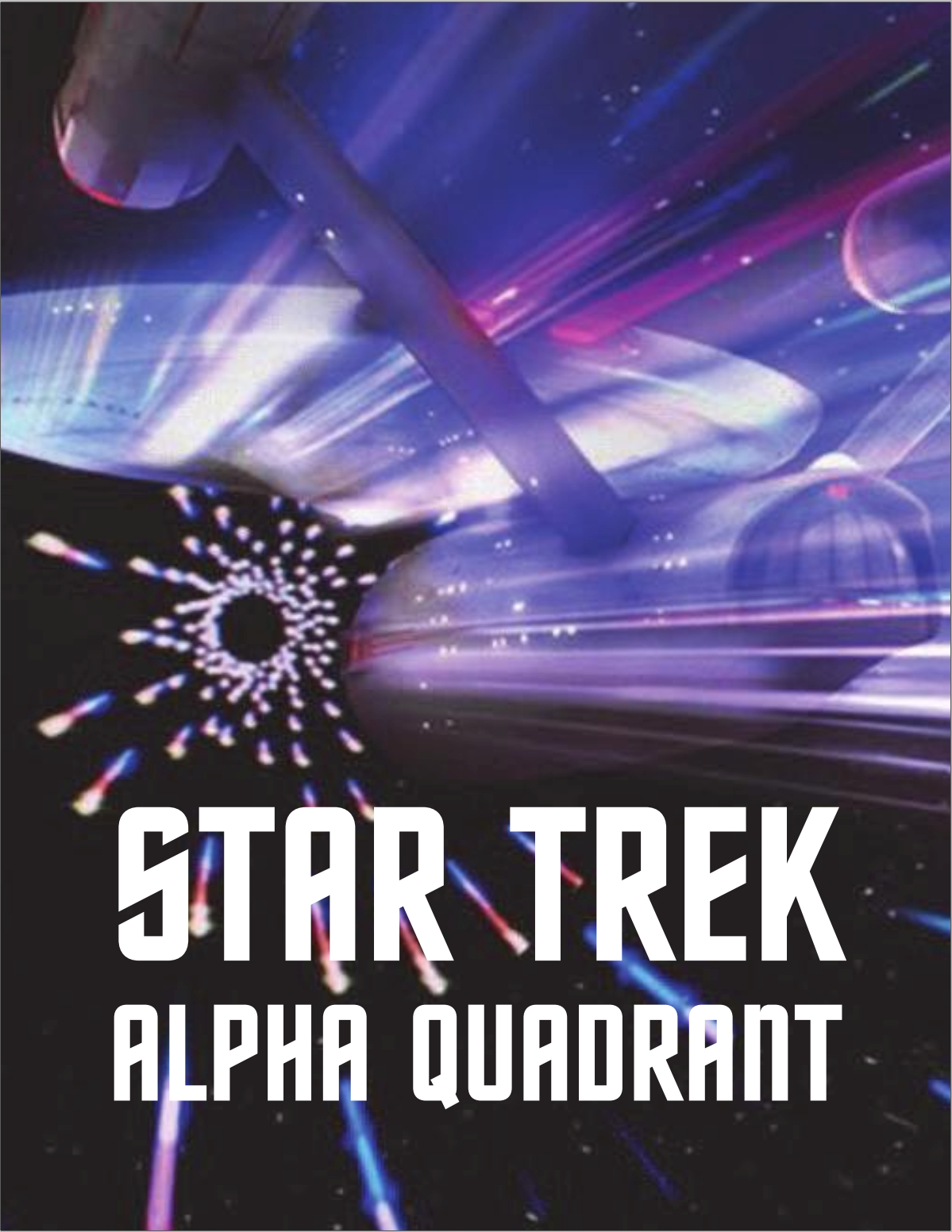
Star Trek: Alpha Quadrant.
Steven J. Ege.
Independently published. Info at
https://goreanmale.homestead.com/files/staq.html Download at
https://pdfcoffee.com/star-trek-alpha-quadrant-pdf-free.html
PDF, 160pp.
Free
It must be noted up front that this product is not authorized by Paramount or any past owner of the Star Trek properties. As a result, the material at the links in the header could be nullified at any time.
This game is completely self-contained; all that is needed is the downloaded PDF file. It is based on (and slightly modified from) Cepheus Engine; its focus is the universe of the various Star Trek series.
One conceit of this game is that the Referee/Game Master is referred to as “Q”, referencing the annoying but extremely powerful antagonist from Star Trek: The Next Generation.
Character creation is recognizeably based on the familiar Traveller character generation process, but has been strongly modifed to accommodate the intended milieu. Unlike standard Traveller and (other) related games, your final rank and position is not determined after character creation; the players negotiate with “Q” what their character’s final rank should be, and apply the character generation rules to achieve that.
To start with, characters are not “mustered out” and at loose ends; instead, they are crewmembers on a Starfleet ship. Even some of the basics are modified; characters do not have SOC (Social Standing) or any replacement for it – a character’s profile string is only five characters, representing the standard character attributes other than SOC. Several alien races from the original series and the animated series are available; all use the same set of attributes, with racial characteristics providing bonuses or penalties to the standard 2D roll for determining the attributes.
You aren’t offered a choice of careers in the sense that standard Traveller rules use it; all characters are crewmembers aboard Starfleet ships. The rules as outlined here allow for adventuring in either a 22nd/23rd century setting (the original series milieu) or a 24th century setting (the Next Generation milieu). It is important to know which setting an adventure will be run in; some “professions” (role selections) can only be used in one milieu or the other.
All characters attend Starfleet Academy and then go on for training in their chosen “profession”; this brings a character’s age to anywhere between 24 and 26 before they start their cadet cruises. Each cadet cruise is six months, and up to five cadet cruises may be taken, bringing the character to an age ranging from 25 to 29 before even starting “tours of duty”. These last are actually optional; a character could be brought into play at this point. However, tours of duty (lasting 2.5 years each) allow for the gaining of additional levels of skills, and are expected of characters that attain sufficient rank to be designated department head or eligible for command.
Skill levels are capped at 5, and any skill levels in excess of this are lost. However, there doesn’t seem to be any limit on the total number of skill levels a character may have; in this, Star Trek Alpha Quadrant follows the cinematic presentation of the television/movie franchise.
Aging is only a factor if “Q” wants it to be in the campaign; if so, rules for handling it are provided.
(All of the above, with plenty of detail, plus the basics of what roleplaying is and the basic Cepheus Engine rules and definitions, is covered in the first 23 pages, covering the Introduction and Chapter 1.)
The standard rules for skills and skill checks are described in Chapter 2, as are the skills themselves. There are some differences here from standard Traveller; for example, there is a Gaming skill that covers most games of skill and/or strategy; Gambling is folded into Carousing, and physical games (ranging from Tag to Baseball and Football and Rock-climbing) are covered by Sport. Some academic skills are broken out as separate skills that are themselves cascade skills. There are also some skills that replace ‘standard’ skills with their nearest equivalents from the Star Trek milieu (e.g., Warp Drive instead of Engineering (Jump Drive)).
Chapter 3 discusses Telepathy, the only ‘psionic’ ability that the rules admit (though it is specifically noted that “Q” may bring in NPCs that may have other abilities). There are only four Telepathic skills, which any character with Telepathy at all will have all of. The rules are fundamentally the same as in Traveller, which limits the amount of actual use of Telepathy in play.
Chapter 4 covers available equipment; there is a good selection covering everything from personal accessories up to mining equipment, vehicles, and weapons. Some alien weapons are included, but not all weapons that have appeared in Star Trek are included.
The Personal Combat rules in Chapter 5 appear to be close to the standard Traveller rules. One notable difference is that initiative is not rerolled from round to round, though actions that a character takes may affect initiative in the following round. This section also covers inflicting wounds and recovery (including medical care). There is a special note on the use of the Vulcan Nerve Pinch.
Chapter 6 covers vehicle combat, both the exceedingly rare ground-vehicle combat and the more common – but still not necessarily frequent – starship combat. Rather than action rolls as in personal combat, vehicle combat is based on skill rolls, and vehicles are designed with “STR” and “END” attributes; damage is taken first to STR, then to END, with the vehicle being reduced to scrap if both attributes fall to zero. Hits are allocated to specific vehicle systems, and can disable a system without necessarily rendering the vehicle hors de combat. Although an unlikely scenario, there are rules for handling ground vehicle weapon attacks against starship-scale targets. Vehicle design is quite simple, basically specifying the STR and END, and providing “cosmetic” text.
The next three chapters echo the advertising copy version of the mission statement from the early Star Trek shows: “To explore strange new worlds; to seek out new life and new civilizations”.
Chapter 7, “Strange New Worlds”, covers generating worlds for your adventure. While a planetary profile has the same characteristics as stock Traveller (and is interpreted the same way for the most part), the generation process differs significantly, and focuses on “Class M” (habitable) worlds. It should be noted that in this game, planetary profiles are written out in a somewhat compact form, but not the completely compressed form of stock Traveller – for example, Earth (stock Traveller X868973-7) would be described as STR X, SIZ 8, ATM 6, HYD 8, POP 9, GOV 7, LAW 3, TL 7; values above 9 are not encoded as “extended hex”. Worlds that have no population also have no starport, government, law level, or tech level, and are reported out with only SIZ, ATM, and HYD. Worlds of classes other than “M” can be generated, but they are not given the attention or detail of the class M worlds.
Chapter 8, “New Life”, provides rules for creating both sentient and non-sentient life forms; these are a close match to the animal generation rules from stock Traveller. It should be noted that a sentient is generated with the same characteristics as a character (STR, DEX, END, INT, EDU); non-sentients use a slightly different set of characteristics (STR, DEX, END, INT, INS [instinct], PCK [pack]). “Sentient” equates to stock Traveller “sophont”, but a sentient generated by these rules will not have achieved any sort of social organization above animalistic behavior.
Chapter 9, “New Civlizations”, doesn’t provide any actual rules, but does offer “Q” some guidelines for fiat-creation of aliens and their civilizations. Most of the chapter is thumbnail descriptions of major aliens that have appeared in the Star Trek franchise.
Chapter 10 is a timeline for the universe; it appears to be a synthesis of the various historical events mentioned in various Star Trek presentations, plus some real history not mentioned (and which may not have been originally part of the timeline, such as the events of September 11, 2001). The dates of the events of the various Star Trek TV series and movies are noted as well. This makes for interesting reading, and should be considered important for playing in a ‘canonical’ setting, but not reading it isn’t necessarily detrimental to play.
Chapter 11, “Foreign Governments”, provides an overview of the governments (other than the Federation) that have “appeared” in the Star Trek franchise. As with the timeline, it’s interesting reading and important for canon conformance, but if your adventures happen to take you out of space known to the Federation (for example, as in Star Trek: Voyager), you don’t actually need this.
Chapter 12 is a detailed look at the structure and history of the United Federation of Planets, including some of the individual episodes behind various events.
Chapter 13 provides an overview of Federation Starfleet ranks, uniforms, and insignia, showing variation in all of them over time.
Chapter 14 presents thumbnail summaries of important characters in the franchise, not all of whom are in Starfleet, but all of whom appeared in either Star Trek: The Original Series or Star Trek: The Next Generation.
Chapter 15, titled “The Final Frontier”, gives an overview of structuring an adventure; the EPIC system is described as the preferred structure, because it allows “Q” to systematically develop and provide all of the elements needed for an adventure. There’s no reason that other structures can’t be used, however, and this is stated in this chapter.
The author starts Chapter 16, “Whose universe is it?” with this product’s “Genesis” story, mentioning past efforts to create a Star Trek TTRPG, including FASA’s Star Trek: The Role Playing Game and the failed partnership between Mongoose and Amarillo Design Bureau to “port” the latter’s Prime Directive game to Mongoose rules. It then goes on to provide a procedure for converting from FASA’s system to the rules outlined in this product. This chapter also includes acknowledgements of sources.
The PDF could almost pass as professionally produced; there are some minor issues that mar a generally excellent product: First, the font chosen for most text appears to be a slightly condensed Eurostile at a light stroke weight; an uncondensed version at a slightly heavier weight would have been more readable. (Eurostile is the “standard” name for the non-extended version of the font that appeared in the original Star Fleet Technical Manual as “Microgramma Extended”, and is considered somewhat ‘iconic’ for Star Trek. It’s a somewhat squared-off sans-serif font that is conducive to confusing upper-case I and lower-case l, and numeral zero and upper-case O, but not numeral one.) The second issue is that the first page of each chapter is white text overlaying a picture; in some cases, the picture is busy enough that the light-weight text gets partly “lost”. Most illustrations seem to be from one or another of the Star Trek TV shows or movies; there are a few that aren’t, and may have been taken from ‘stock’ photo collections.
Over all, Mr Ege has done a credible job of creating a Star Trek role-playing game based on
Cepheus Engine rules. It’s
not compatible with other Traveller
or Cepheus games, but
it’s similar enough that those who are familiar with the
system won’t have a problem “getting into”
this. This is definitely a worthwhile download for Traveller/Cepheus fans who also have good
memories of Star Trek.